

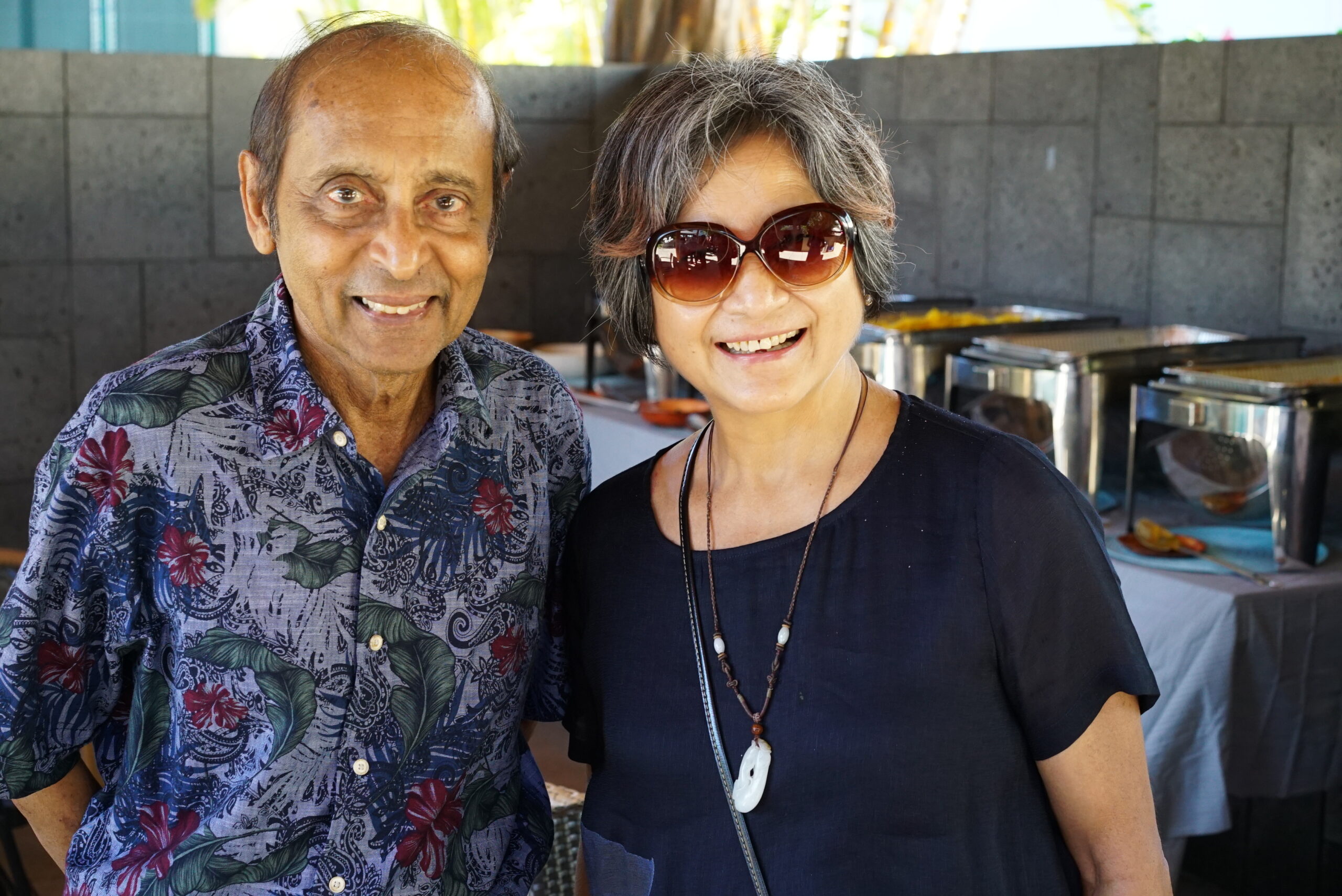
Wimal Dissanayake with Hong Kong film icon Cheng Pei Pei (COME DRINK WITH ME) during HIFF 2016
The Hawai‘i International Film Festival mourns the passing of Dr. Wimal Dissanayake (September 6, 1939–August 7, 2026), a pioneering scholar of Asian cinema and communication whose intellectual legacy is deeply connected to the origins of HIFF—and to Hawai‘i’s unique place as a crossroads of cultures.
Born in Sri Lanka, Wimal became one of the leading international voices in Asian film and communication studies. As a Senior Fellow and Assistant Director of the Institute of Culture and Communication at the East-West Center in Honolulu, he approached cinema not simply as entertainment, but as art, communication, cultural memory, and an expression of national identity.
He was also the founding editor of the East-West Film Journal, an influential publication that placed Asian cinema in conversation with international and Western film traditions while taking seriously the cultural contexts from which those films emerged.
That intellectual environment was part of the foundation from which HIFF grew.
When Jeannette Paulson founded the Hawai‘i International Film Festival at the East-West Center in 1981, Wimal was among the scholars and cultural thinkers helping define the Center as a meeting place for ideas from Asia, the Pacific, and the United States. He was a fixture of HIFF during its formative first decade and a significant presence within Asian and media studies at the University of Hawai‘i at Mānoa.
His legacy is also personal for me.
As a college student at UH Mānoa, my awakening to global cinema happened on that campus. I spent countless hours at Sinclair Library watching VHS tapes of films from around the world. There were regular screenings on campus—often on 16mm and 35mm—and at what was then the Honolulu Academy of Arts theater. This was long before streaming made film history instantly accessible. Discovering a movie meant actively seeking it out. It was during those years that I discovered Wong Kar Wai and the extraordinary cinema coming out of Hong Kong. Together, those films, screenings, and writings expanded my understanding of what cinema could be.
Wimal embodied the idea of the cross-cultural, cultural worker. His perspective also complicated the traditional East-West binary. Through his work in Asian communication theory, Wimal challenged the assumption that Asian cultures needed to be understood primarily through Western critical frameworks. His examination of Hong Kong cinema was especially significant: he approached it as an outsider, but from an Eastern perspective that offered an alternative to the predominantly Western gaze of English-language film scholarship at the time.
For me, that remains one of the most important aspects of his legacy. Today, filmmakers such as Wong Kar Wai, Edward Yang, Hou Hsiao-hsien, Ann Hui, John Woo, Tsui Hark and many others are firmly embedded within international film history. But their global recognition was also supported by generations of scholars, programmers, archivists, critics, teachers, and institutions that built bridges between films and audiences.
Wimal Dissanayake was one of those bridge builders.
His scholarship belongs to a pioneering generation of writers who expanded how Asian cinema was understood internationally. But for HIFF, his legacy has an even more immediate resonance. The Festival did not emerge in isolation. It grew from an extraordinary ecosystem surrounding the East-West Center and the University of Hawai‘i—a community that believed cinema could be a vehicle for genuine cultural exchange, “when strangers meet.”
I can trace a direct line from those afternoons and late nights at Sinclair Library, those film screenings around Honolulu, and those pages of the East-West Film Journal to the work I do today. They taught me that cinema was larger than Hollywood or any single national industry—and that Hawai‘i could be an extraordinary vantage point from which to see the world through film.
More than four decades after HIFF began at the East-West Center, that idea remains central to who we are.
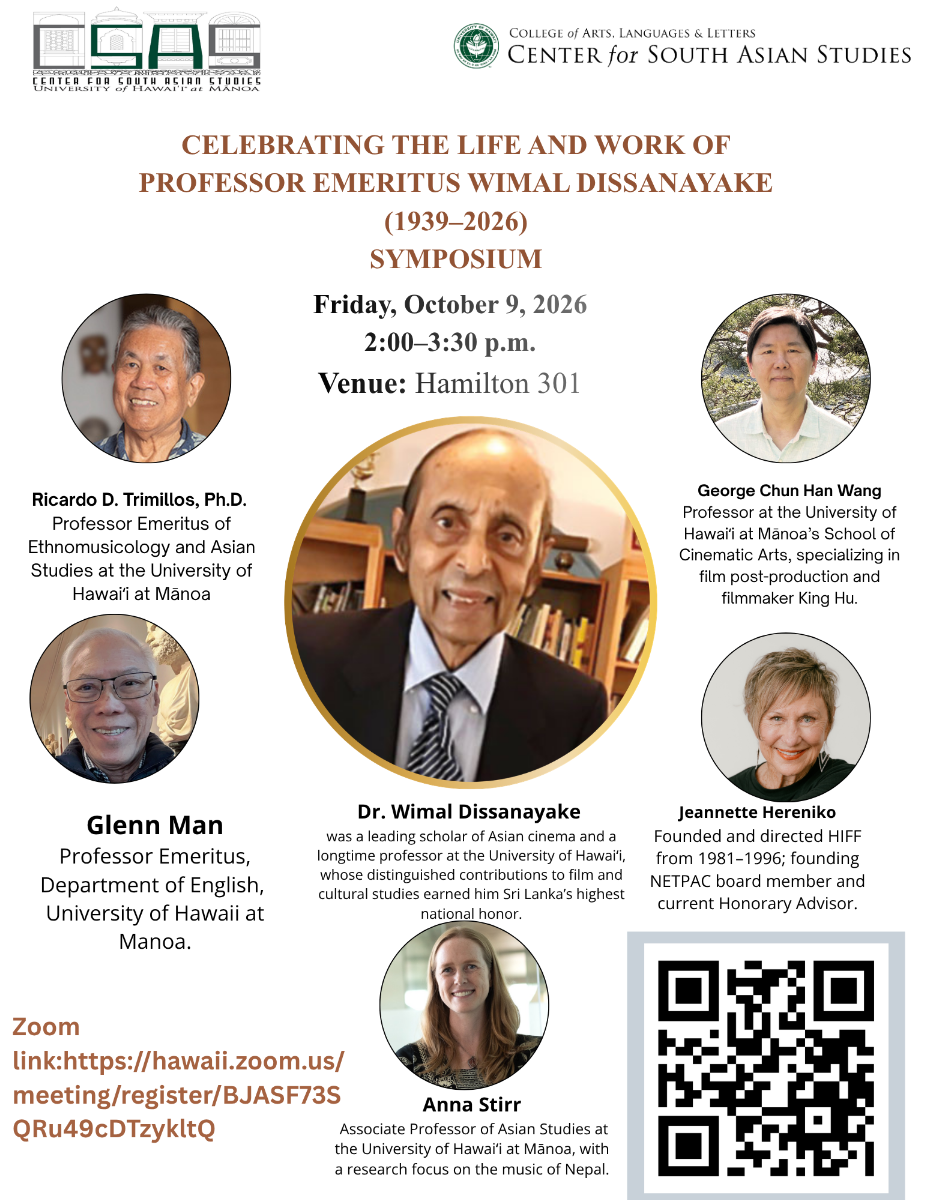
Celebration of the Life of Wimal Dissanayake
On October 9, the Center for South Asian Studies at the University of Hawai‘i at Mānoa will host a Celebration of the Life of Wimal Dissanayake, bringing together colleagues, students, friends, and members of the community to remember his life and extraordinary scholarly legacy. The celebration will be held on the UH Mānoa campus, with an option to participate via Zoom.
Anderson Le is the Artistic Director of the Hawai’i International Film Festival.