

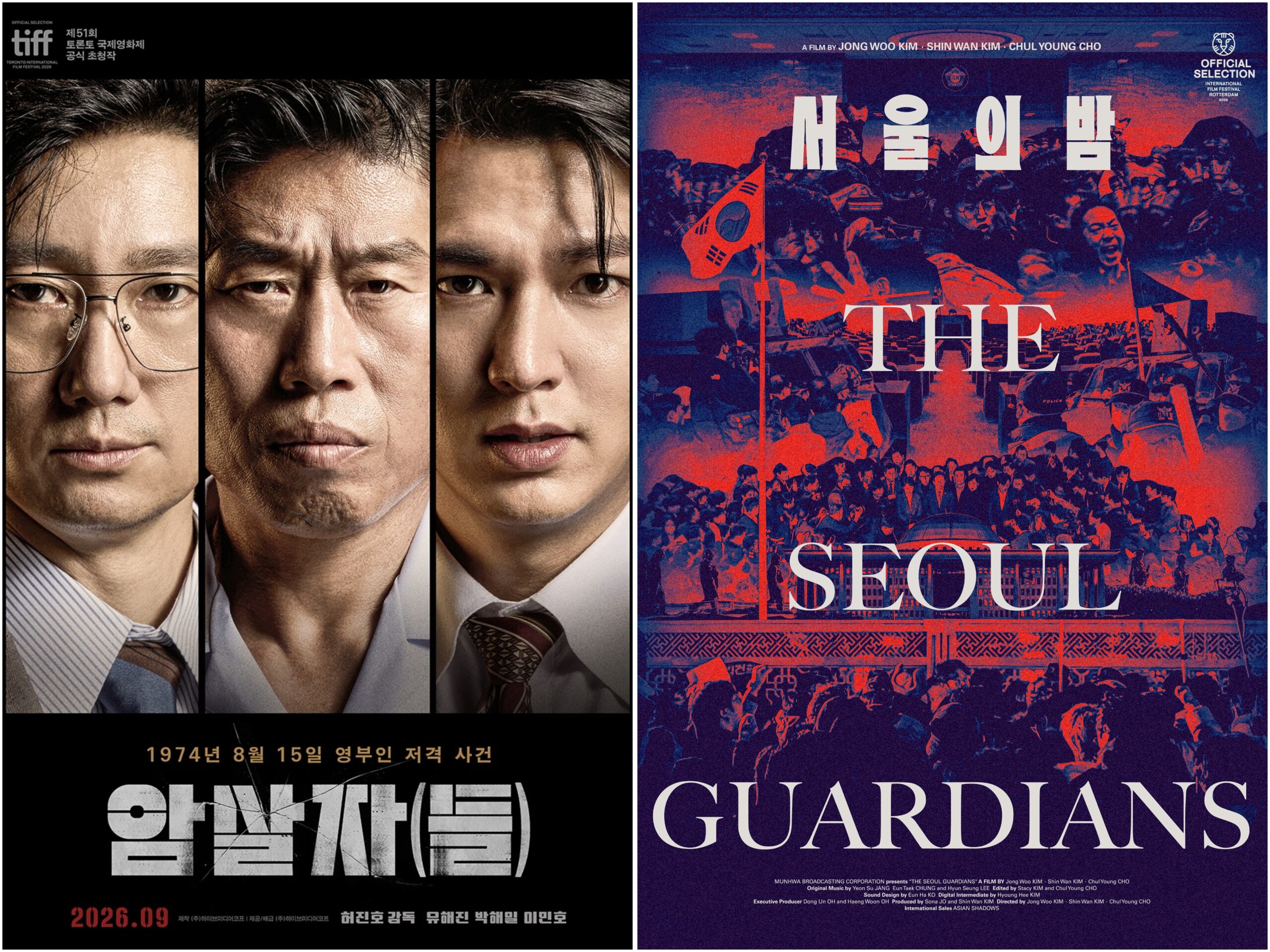
From a controversial Korean box-office hit to a gripping documentary about South Korea’s recent martial law crisis, two films at HIFF46 explore the power of journalism, the fragility of democracy, and a nation’s ongoing reckoning with its political history.
Following its world premiere at the Toronto International Film Festival and a strong theatrical run during South Korea’s Chuseok holidays, Hur Jin-ho’s THE ASSASSIN(S) has emerged as one of the country’s most talked-about films of the year. But its box-office success has also ignited a political firestorm, reopening decades-old wounds and raising questions about historical truth, artistic freedom, and the power of cinema to challenge official narratives.
Starring Yoo Hae-jin, Park Hae-il, and Lee Min-ho, THE ASSASSIN(S) revisits the 1974 assassination attempt on President Park Chung-hee that resulted in the death of First Lady Yuk Young-soo. Through the investigation of a police detective and two journalists, the film explores competing accounts of the tragedy and the possibility of a larger conspiracy.
However, THE ASSASSIN(S) has started a political firestorm in South Korea. The film has drawn fierce criticism from conservative political circles, including accusations of historical inaccuracies, outright fabrications, and the promotion of conspiracy theories. Conservative politicians and organizations associated with Park Chung-hee’s legacy have publicly condemned the film, with some calling for apologies and the suspension of screenings. The controversy has reached beyond South Korea’s borders, with conservative lawmakers demanding that the film be dropped from the Singapore International Film Festival lineup (SGIFF had recently announced the film as Opening Night).
The backlash has extended beyond political statements, with protests, legal complaints, and reported security concerns surrounding members of the cast. Meanwhile, the filmmakers have defended their creative approach, emphasizing the distinction between historical fiction and documentary fact.
At the heart of the controversy is a compelling question: Who gets to tell history, and where does historical fact end and artistic interpretation begin?
For HIFF, these questions are precisely why THE ASSASSIN(S) deserves to be seen and discussed.
In the tradition of JFK and other great political thrillers, THE ASSASSIN(S) was programmed at HIFF because it belongs to a distinguished lineage of political and conspiracy thrillers that challenge audiences to question authority, scrutinize official narratives, and confront the ambiguities of history.
Oliver Stone’s JFK remains the quintessential American example. Its riveting exploration of President John F. Kennedy’s assassination sparked enormous controversy over historical liberties and conspiracy theories surrounding one of America’s most enduring mysteries—a subject that continues to fill libraries with investigations, speculation, and formerly classified government records.
Yet JFK is also a work of fiction, condensing historical events, dramatizing testimony, and employing composite characters to construct a compelling cinematic narrative. Its power lies not in establishing definitive historical truth, but in challenging audiences to interrogate what they think they know.
THE ASSASSIN(S) operates in a similar tradition.
It also shares cinematic DNA with ALL THE PRESIDENT’S MEN and SPOTLIGHT, two landmark films celebrating investigative journalism and the essential role of a free press in holding powerful institutions accountable. In THE ASSASSIN(S), journalists become central figures in the search for truth, confronting political intimidation, institutional secrecy, and the consequences of asking uncomfortable questions.
THE ASSASSIN(S) also belongs to a remarkable tradition of Korean cinema confronting the nation’s authoritarian past and hard-fought democratic freedoms. In Jang Hoon’s A TAXI DRIVER transformed the 1980 Gwangju Uprising into a powerful story of ordinary citizens, resistance, and the courage of journalists who risked their lives to expose state violence. Im Sang-soo’s THE PRESIDENT’S LAST BANG employed biting black comedy and political satire to revisit the 1979 assassination of President Park Chung-hee, generating controversy of its own over its depiction of historical figures.
Like these films, THE ASSASSIN(S) reflects Korea’s beating heart: a nation’s continuing struggle to reckon with authoritarianism, defend democratic freedoms, and confront the difficult chapters of its history.
THE SEOUL GUARDIANS: An Essential Companion Film
Perhaps the most compelling reason to see THE ASSASSIN(S) at HIFF46 is its extraordinary connection to another official selection, THE SEOUL GUARDIANS. Where THE ASSASSIN(S) revisits the political turmoil of the 1970s through the lens of historical fiction, THE SEOUL GUARDIANS documents a democratic crisis that unfolded just two years ago.
On December 3, 2024, South Korean President Yoon Suk Yeol shocked the nation by declaring martial law. As soldiers and police surrounded the National Assembly, lawmakers scrambled to overturn the order while thousands of ordinary citizens poured into the streets of Seoul, placing themselves between armed troops and the democratic institutions they were determined to protect.
THE SEOUL GUARDIANS captures this extraordinary moment through the perspectives of citizens and journalists who witnessed history unfolding in real time.
The October 28 screening of THE SEOUL GUARDIANS will be followed by a special live Zoom discussion with the Seoul-based filmmakers, to be moderated by HIFF executive director Jean Lee. The directors — Kim Jong-woo, Kim Shin-wan, and Cho Chul-young are also journalists at MBC. This rare opportunity allows HIFF audiences to engage directly with the people documenting South Korea’s contemporary democratic struggles, hear firsthand accounts of the crisis, and explore the vital role of independent journalism in holding power accountable.
Together, THE ASSASSIN(S) and THE SEOUL GUARDIANS form a powerful cinematic dialogue across generations.
One examines the contested historical narratives of an authoritarian past. The other captures ordinary citizens defending democracy against an authoritarian threat in the present. Both place journalism, accountability, and the search for truth at the center of their stories.
At a moment when democratic institutions, freedom of expression, and independent journalism face mounting pressures around the world, these two films remind us that democracy is neither inevitable nor permanent. It must be continually defended, questioned, and renewed.
HIFF believes in cinema’s ability to challenge conventional narratives, provoke meaningful dialogue, and connect audiences across cultures and generations.
Whether through the dramatized historical intrigue of THE ASSASSIN(S) or the urgent documentary immediacy of THE SEOUL GUARDIANS, these films invite us to consider how history is written, who controls its narratives, and what happens when ordinary people refuse to remain silent.
We encourage HIFF46 audiences to experience both films as essential companion screenings—and to join the October 28 live filmmaker discussion for THE SEOUL GUARDIANS. Together, they offer a fascinating and timely examination of South Korea’s political past and present, and a powerful reminder of why the fight for truth and democracy matters everywhere.
In addition, the Festival encourages you to also see the other selections in this year’s SPOTLIGHT ON KOREA.