

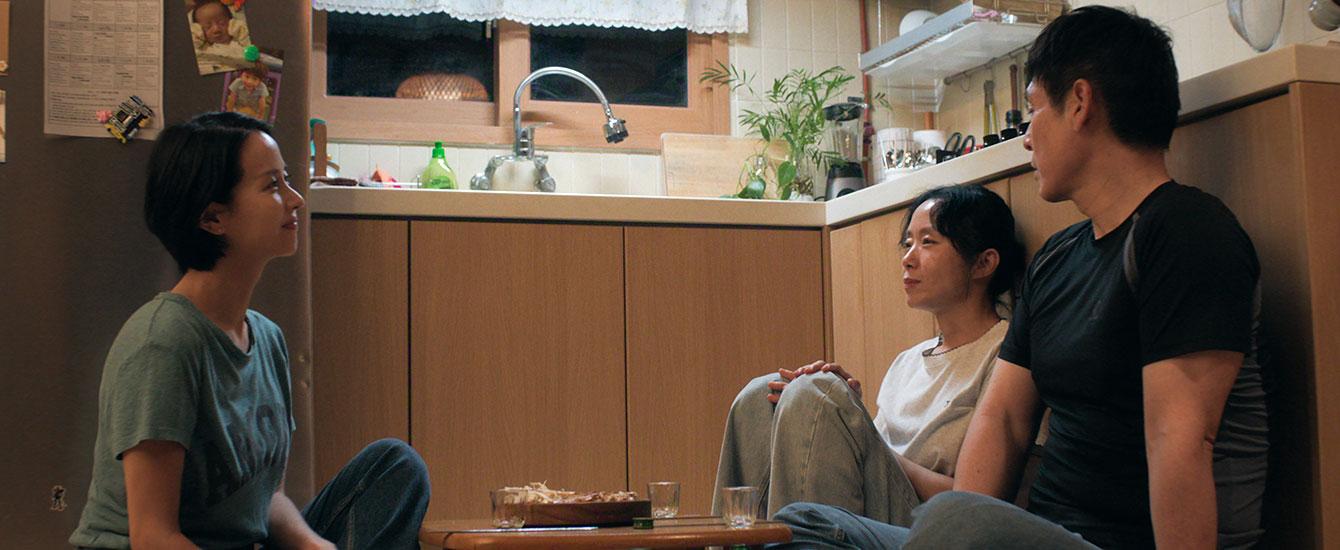
A Review of POSSIBLE LOVE, Directed by Lee Chang-dong
Over drinks in POSSIBLE LOVE (2026), Han Sang-woo (Zo In-sung) says, “Workers are invisible to us.” “Soon, workers will disappear.” He is talking about a visit to Qatar with his wife, Lee Ye-ji (Cho Yeo-jeong). A “paradise” has been built in the desert, but the workers who keep it running remain out of sight. It is uncomfortable to confront the reality that this fantasy of paradise is sustained by someone else’s labor. Because paradise is not supposed to make us feel such discomfort, it hides its workers.
Ahn Mi-ok (Jeon Do-yeon), a worker sitting with them, does not give much weight to Sang-woo’s words. Instead, she is drawn to the way he seems to say such impressive things. As she later explains over dinner, he is like “Steve Jobs” to her. He seems to “know everything” and to “have a solution for everything.” Labor issues matter to Mi-ok, but the way capitalists and intellectuals discuss them does not speak to her. To someone who does the actual work, his abstract ideas make little difference.
When the conversation ends, Mi-ok steps outside the bar to smoke. Sang-woo follows shortly afterward and makes a phone call. They stand almost facing each other. Mi-ok glances at him, clearly aware of his presence, but Sang-woo focuses only on his call. Mi-ok, the worker, is invisible to him. The film frames both characters in a full shot, placing them on opposite sides of the screen to reveal the distance between them. Can Sang-woo not see workers, or does he choose not to look?
As Sang-woo suggests, perhaps we live in a world that tries to hide its workers. Everyone wants to live in a spotless paradise. At the same time, they expect workers to keep working like machine parts somewhere out of sight. Ye-ji challenges this idea. During a presentation for independent film funding, she argues that labor issues will still matter even if AI robots arrive or the world no longer needs workers. She believes that restructuring and layoffs, like those at SP Heavy Industries, will become part of everyday life. She puts her concern for workers into action. She picks up a camera herself.
Her decision to pick up a camera matters, but so does her decision to make a documentary. The word “documentary” can be traced back to the Latin docere, meaning “to teach,” “to show,” or “to make known,” and documentum, meaning “a lesson,” “an example,” or “evidence.” Unlike Sang-woo, she does not approach labor issues only through abstract ideas. She steps beyond her position as a capitalist’s wife and enters the workers’ world, standing somewhere between intellectuals and workers. This is the first step toward making her love for workers possible.
Yet Ye-ji is not ready to be a filmmaker. Early in the film, at a funeral, she removes her camera from its tripod to film Ho-seok (Sul Kyung-gu) and Mi-ok arguing over his drinking. She approaches them in the name of documenting the scene, but handles the situation clumsily. Ho-seok finally rebukes her: “Does this look entertaining to you?” Only after her documentary is already underway does she see footage of police beating him. If she truly cared about labor issues, particularly the layoffs at SP Heavy Industries, should she not have watched this footage before her funding presentation? Mi-ok’s comment about her clothes is also telling: “That outfit stands out a little here. You’re filming laid-off workers, you know.”
At the same time, the film shows how Ye-ji grows as both a filmmaker and a person. Despite her shortcomings, she gradually begins to understand what it means to truly love workers. Her decision to wear only plain T-shirts after Mi-ok’s comment is a beginning. The scene in which she discovers the footage of Ho-seok being beaten is also important. The shot is brief, but her shocked expression as she recognizes his face shows that she has confronted the reality of workers’ lives. That expression returns when she interviews him at the vacation home. This time, however, Ye-ji steps in front of the camera to help him as he struggles. She places a hand on his shoulder as his breathing grows rapid. Through this encounter, she learns that labor issues do not exist only somewhere out of sight. If she moves a little closer, they become a reality right before her, close enough to touch.
Ye-ji still falls short. When Mi-ok embraces the distressed Ho-seok during the interview—when she gets in front of the camera and interrupts the filming—Ye-ji becomes someone who needs to finish her film again. She shifts from trying to make the reality of workers’ lives known to simply recording what is before her. Near the end, she stands in a doorway and asks, “Have you seen the whistle?” The question reveals that her love remains uncertain and open to doubt. But having confronted her limitations as a filmmaker and a person, she immediately begins to cry.
In the tearful Ye-ji, we see director Lee Chang-dong himself. The layoffs at SP Heavy Industries are based on the 2009 SsangYong Motor labor dispute in South Korea. Workers occupied the factory for 77 days to protest mass layoffs, and the authorities violently suppressed the strike. A police fact-finding committee investigating human rights violations later acknowledged unlawful conduct and excessive violence during the crackdown. In 2019, the commissioner general of the Korean National Police Agency issued a formal apology. Yet the state continued its lawsuit seeking damages from the workers. In the aftermath of the layoffs and the crackdown, workers and their families faced financial hardship, psychological suffering, and social isolation. Some died by suicide. The incident remains a deep stain on South Korea’s labor history.
In an interview with film critic Lee Dong-jin, Lee Chang-dong explained that he had researched the incident because he saw it as a major example of market logic consuming Korean society. The interview appears in the YouTube video “Questions I Wanted to Ask About Every Scene: Revisiting Possible Love With Lee Chang-dong.” But the more he researched, the more he confronted the victims’ worsening suffering in the years that followed. He began to ask himself, “What gives me the right to tell their stories?” He eventually abandoned the project during preproduction. He had reached an ethical limit: How could he convey the suffering of others?
Screenwriter Oh Jung-mi, who shared his concerns, suggested a way forward: adding a married couple making a documentary. This allowed Lee to add another question to the problem of portraying others’ suffering—the question of his own role in telling their stories. He thought that by showing his limitations and guilt as honestly as possible, he could make the film a form of confession and self-reflection. Cinematographer Kim Ji-yong described their approach: “We wanted to keep lighting to a minimum by using natural light, remove all the equipment that helps with camera movement, and simply shoot with the camera on our shoulders.” This approach came from Lee’s suggestion that he wanted to film “with a sense of detachment,” as reported in The Korea Economic Daily article “Possible Love Comes Into View by Stripping Things Away.” He wanted to portray the suffering of others with as neutral and ethical an approach as possible.
Despite his sense of limitation and guilt, Lee Chang-dong does not hide his love for workers. Even knowing that this love may be impossible, he tries to make it possible. It is an honest and ethical love. That is why he does not let workers disappear from his film. They may seem hidden, but, like Ye-ji, we can see them if we pay a little more attention. There are the migrant workers (Abraha Mehret Ephrem, Su Pyae Sone, Gurpreet Kaur, Sinha Aradhya, and Kumarawany Benitha), who watch cautiously from the background as Mi-ok organizes a labor union. There is Min-sik (Kang Chan-kwon), the caretaker at Sang-woo’s vacation home, seen through a car window. And there is the ethnic Korean woman from China (Lee Chung-yeon) preparing a meal. Here is a paradise different from Qatar. This film is a paradise where workers can be seen.
노동자를 감춘 낙원, 노동자를 비추는 영화
영화 <가능한 사랑>(2026) 속 한상우(조인성)가 술자리에서 말한다. “노동자들은 우리 눈에 보이지 않는다.” “이제 노동자들은 사라지게 돼.” 부인 이예지(조여정)와 함께 카타르에 갔을 때 한 말이다. 사막 위에 ‘낙원’이 세워져 있지만, 그 낙원을 돌아가게 하는 ‘노동자’는 드러나지 않는다. 낙원이라는 ‘환상’의 공간이 실은 “누군가의 노동의 대가”로 유지된다는 ‘현실’을 마주하는 것은 불편한 일이다. 낙원은 그런 불편함을 느끼는 곳이어서는 안 되기에 노동자를 감추는 것이다.
이 술자리에 함께 있는 ‘노동자’ 안미옥(전도연)은 상우의 이야기를 그다지 중요하게 받아들이지 않는다. 오히려 멋있는 이야기를 하는 듯한 상우의 모습에 눈길이 간다. 이후 저녁 식사 자리에서 말하듯, 그녀에게 상우는 ‘스티브 잡스’처럼 “뭐든지 다 아는 것 같은”, “뭐든지 다 해결해 줄 것 같은” 사람이다. 미옥에게 노동 문제는 중요하지만, 자본가나 지식인이 하는 노동에 관한 이야기는 와닿지 않는다. ‘진짜’ 노동을 하는 사람에게 그의 ‘개념’적인 이야기는 하나 마나 한 소리다.
이야기가 끝나자 미옥은 술집에서 나와 담배를 피운다. 곧이어 나온 상우는 전화를 한다. 두 사람은 마주 보듯 서 있다. 미옥은 상우를 흘깃 보며 그를 의식하지만, 상우는 전화에만 집중한다. 노동자 미옥은 상우의 눈에 보이지 않는다. 영화는 두 사람을 풀 쇼트로 잡아내고 화면 좌우에 각각 배치해 그들 사이의 거리를 드러낸다. 상우에게 노동자는 보이지 않는 것일까, 아니면 그가 보지 않으려는 것일까.
상우의 말대로 우리는 노동자를 숨기려 하는 세상에 살고 있는지도 모른다. 모두 말끔한 낙원에서 살고 싶어 한다. 그러면서 노동자들이 보이지 않는 어딘가에서 부품처럼 일하기를 바란다. 예지는 여기에 문제를 제기한다. 그녀는 ‘독립영화 제작 지원’ 발표에서 AI 로봇이 등장하거나 노동자가 아예 필요 없는 세상이 오더라도 노동 문제는 여전히 중요하다고 말한다. ‘SP 중공업 해고 사태’와 같은 구조조정 문제가 ‘일상’이 될 것이라고 본다. 그녀는 노동 문제에 대한 진심을 행동으로 보여 준다. 직접 ‘카메라’를 든 것이다.
그녀가 카메라를 들었다는 것도 중요하지만, ‘다큐멘터리(Documentary)’를 만든다는 사실 역시 중요하다. 다큐멘터리의 어원을 거슬러 올라가면 ‘가르치다’, ‘보여 주다’, ‘알게 하다’를 뜻하는 라틴어 docere와 ‘가르침’, ‘본보기’, ‘증거’를 뜻하는 documentum에 닿는다. 그녀는 상우처럼 개념적으로만 노동 문제에 접근하지 않는다. 자본가의 아내라는 위치에서 벗어나 지식인과 노동자 사이 어딘가에 서서 현장에 발을 들인다. 노동자에 대한 그녀의 사랑이 가능해지기 위한 시작인 셈이다.
그러나 예지는 아직 준비되지 않은 감독이다. 영화 초반 장례식장 장면에서 그녀는 삼각대에서 카메라를 떼어 내 술 문제로 실랑이를 벌이는 호석(설경구)과 미옥을 찍는다. 현장을 스케치한다는 명분으로 두 사람에게 다가갔지만 서툴렀다. 결국 그녀는 호석에게 “이게 재밌어 보여요?”라는 꾸중을 듣는다. 그녀는 다큐멘터리 제작이 어느 정도 진행된 이후에야 호석이 경찰에게 구타당하는 장면을 보기도 한다. 노동 문제에, 특히 SP 중공업 해고 사태에 진심으로 관심이 있었다면 독립영화 제작 지원 발표 전에 이 영상을 봤어야 하지 않을까. 그녀를 향한 “그 옷이 여기서는 좀 튀는 것 같아. 지금 해고 노동자들 찍고 있잖아”라는 미옥의 지적도 이런 점에서 의미심장하다.
다른 한편으로 이 영화는 예지가 감독으로서, 인간으로서 어떻게 성장하는지를 보여 준다. 예지는 부족한 모습을 보이지만 점차 노동자에 대한 진짜 사랑을 알아 간다. 옷에 대한 지적을 받은 이후 평범한 티셔츠만 입는 것이 그 시작이다. 호석이 구타당하는 모습을 찾아내는 장면도 중요하다. 짧은 쇼트이지만, 영상 속에서 호석의 얼굴을 발견한 예지의 충격 어린 표정은 그녀가 ‘진짜’ 노동의 현실을 마주했음을 보여 준다. 이 표정은 별장에서 호석을 인터뷰할 때 다시 나타난다. 하지만 이때 예지는 카메라 앞으로 나와 고통스러워하는 호석을 직접 돕는다. 그리고 호흡이 가빠진 그의 어깨에 손을 얹는다. 이를 통해 그녀는 노동 문제가 보이지 않는 곳에만 있는 것이 아니라, 조금만 다가가면 눈앞에서 손으로 만질 수 있는 현실임을 알게 된다.
예지는 여전히 부족하다. 인터뷰 도중 고통스러워하는 호석을 미옥이 안을 때, 즉 미옥이 카메라 앞에서 ‘촬영’을 방해할 때, 예지는 영화를 완성해야 하는 사람으로 돌아온다. 노동 문제를 알게 하려는 사람에서 그저 눈앞의 모습을 녹화하는 사람으로 돌아오는 것이다. 마지막에 문턱에 서서 던지는 “호루라기 못 봤어?”라는 말은 그녀의 사랑이 여전히 불확실하고 의심스럽다는 것을 드러낸다. 다만 감독으로서, 인간으로서 자신의 한계를 마주한 그녀는 곧바로 눈물을 흘린다.
눈물을 흘리는 예지의 모습은 이창동 감독 자신의 모습이다. 영화 속 SP 중공업 해고 사태는 2009년 한국에서 발생한 쌍용자동차 사태를 바탕으로 만들어졌다. 기업의 대규모 정리해고에 맞서 노동자들이 77일간 점거 파업을 벌였고, 공권력이 이를 폭력적으로 진압한 사건이다. 이후 경찰청 인권침해 사건 진상조사위원회는 진압 과정의 위법성과 과도한 폭력을 인정했고, 2019년 경찰청장은 공식 사과했다. 그러나 국가가 노동자들을 상대로 제기한 손해배상 소송은 계속됐다. 해고와 진압 이후 생계의 어려움과 정신적 고통, 사회적 고립에 내몰린 노동자와 가족들 가운데 일부는 스스로 목숨을 끊기도 했다. 한국 노동사의 큰 오점으로 남은 사건이다.
이창동 감독은 영화평론가 이동진과의 인터뷰(유튜브 영상 「장면마다 묻고 싶었던 이야기. 이창동 감독과 되짚어 보는 [가능한 사랑]」)에서 이 사태를 시장 논리가 한국 사회를 잠식한 중대한 문제로 보고 취재했다고 밝혔다. 하지만 취재를 거듭할수록 사태 이후 더욱 심각해지는 피해자들의 고통을 마주하며 “내가 이들의 이야기를 전할 자격이 있는가”라고 자문했고, 결국 프리프로덕션 단계에서 제작을 포기했다. “타인의 고통을 어떻게 전하느냐”라는 윤리적 한계에 봉착했기 때문이다.
이 문제를 함께 고민하던 오정미 작가는 다큐멘터리를 제작하는 부부 캐릭터를 추가해 해결책을 찾아보자고 제안했다. 이를 통해 이 감독은 타인의 고통을 다루는 문제에 “그것을 전하는 나의 문제”를 더할 수 있었다. 그는 한계와 죄책감을 느끼는 자신의 모습을 최대한 솔직하게 영화에 담으며, 일종의 자기 고백과 자기반성의 영화를 만들 수 있을 거라 생각했다. “자연광으로 조명을 최소화하고, 카메라워크를 돕는 장비를 모두 빼고 그냥 어깨에 둘러멘 채 찍으려고 했다”라는 김지용 촬영감독의 말은 영화를 “무심하게 찍고 싶다”는 이창동 감독의 제안에서 비롯된 것이다(한국경제, 「비우고 덜어내니 비로소 보이는 ‘가능한 사랑’」). 그는 최대한 중립적이고 윤리적인 태도로 타인의 고통을 담고자 했다.
이창동 감독은 한계와 죄책감을 느끼면서도 노동자를 사랑하는 마음을 숨기지 않는다. 그것이 불가능한 사랑임을 알면서도 가능한 사랑이 되도록 노력한다. 이것은 솔직하고 윤리적인 사랑이다. 그래서 그는 영화 속에서 노동자의 모습이 사라지지 않게 한다. 숨겨 놓은 것 같지만, 우리는 예지가 그랬던 것처럼 조금만 신경 쓰면 그들을 볼 수 있다. 미옥이 노동조합을 만들 때 뒤에서 눈치를 보던 외국인 노동자들(Abraha Mehret Ephrem, Su Pyae Sone, Gurpreet Kaur, Sinha Aradhya, Kumarawany Benitha), 상우의 별장에서 차창 너머로 보이는 관리자 민식(강찬권), 그리고 식사를 준비하던 조선족 아주머니(이충연) 등. 카타르와는 다른 낙원. 이 영화는 노동자가 ‘보이는’ 낙원이다.
The HIFF ONLINE CREATIVES & CRITICS IMMERSIVE (HOCCI) program supports sustainable film criticism in Hawai’i through mentorship and paid career opportunities for Hawai’i-based AANHPI critics. The mission of HOCCI is to broaden diversity in film criticism across the Pacific and use influencer branding strategies to spark career opportunities. The 2026 HOCCI is supported by Critical Minded, a grant-making and learning initiative that supports cultural critics of color in the United States.
 Junseok Eom began his career in South Korea as a film critic, festival programmer, and video producer. He served as a jury member at the Busan International Short Film Festival and as Program Director for the Busan International Kids and Youth Film Festival. Eom wrote film criticism for Cultura and has contributed film-related articles to Kyungsang Ilbo since 2026. After moving to the U.S., he produced digital content for NRDC, an environmental advocacy organization. He currently works at KBFD-TV in Hawai‘i as a news video editor and commercial/documentary producer, while expanding his work in U.S. film criticism and festivals.