

A Review of THAT DAY, ON THE BEACH, Directed by Edward Yang
THAT DAY, ON THE BEACH (1983) follows people who struggle to find love and happiness in Taipei, Taiwan’s capital, in the 1980s. Their lives are tragic for different reasons. Lin Jiali (Sylvia Chang) has lost her husband, Cheng Dewei (David Mao). Whether he disappeared into the sea or simply went somewhere else remains an open question. Tan Weiqing (Terry Hu), who meets Jiali again after thirteen years, has also lost someone. He was Jiali’s older brother, Lin Jiasen (Gao Ming-hong), the man Weiqing once loved. Jiasen married someone else at his father’s insistence. Only now does Weiqing learn from Jiali that he died of cancer the previous winter. Dewei’s longtime friend A-Cai (Hsu Ming) says that after Dewei disappeared, NT$50 million was found to be missing from the company’s accounts. Jiali’s college friend Xinxin (Li Lieh) has been with several men. Since the father of her child left, she has been raising the child on her own.
Two forces shape these tragedies. One is Confucian patriarchy. The other is the rapid growth of capitalism. Jiali and Jiasen’s father (Nan Jun) is a doctor who runs a clinic in a small town in southern Taiwan. He chooses whom each of his children will marry and insists that they obey him. The family home, where he also sees his patients, gives us a sense of his success as a doctor. The rooms are neat and filled with sunlight. Yet to his daughter, this beautiful house is a cage she knows she must one day escape. Unable to accept the marriage her father has arranged, Jiali leaves in the middle of the night. Her shadow passes across a paper door, slipping between the narrow strips of its wooden lattice. On a second look, the lines of the lattice and the floor form a grid that brings to mind the bars of the birdcage hanging inside the house.
Jiasen cannot escape as his younger sister does. The camera moves more freely here than anywhere else in the film, just when Jiasen seems most confined. As Jiali and her mother return from a walk, the camera starts outside the house, follows the wall down a corridor, and enters the living room. The room is dark after the daylight outside. Jiasen is on his knees. Scattered in front of him are the pieces of a dish his father seems to have thrown. His mother enters and silently picks them up like a servant in her own home. The camera moves left to find Jiali standing in the corridor. Unable to enter the room or leave the house, she stands there watching. The next shot takes us even farther back from the living room. Jiasen is still on his knees before his father. Three thick tree trunks stand in the foreground. A birdcage hangs alone on the right. Jiasen eventually marries a woman he does not want to marry. For the rest of his life, he regrets having done as his father wished that day.
Once outside the cage, Jiali seems to have found a different life from her brother’s. But the rapid growth of capitalism brings another kind of suffering. After leaving home, she marries Dewei, the man she loved in college. They have little to their names. As they hurry to register their marriage, Jiali takes her husband’s hand and holds it tight. In the close-up of their joined hands, we see the happiness she has dreamed of. Before long, Dewei is busy overseeing operations at A-Cai’s company. One night he says he has to look over a site in Taichung and drives off. Later, Jiali learns from someone else that her husband has even been to Japan. As he spends more time away from home, she begins to fear that he is seeing another woman. Seeing how worn down his wife is by worry, Dewei, too, recognizes the cracks in their marriage. Look at the front door of the apartment they move into in Taipei. Thick iron bars run from top to bottom, with a pattern of squares between them. In opening that door, Jiali has stepped into another cage.
Perhaps Taipei, or even Taiwan itself, is a cage, the film suggests. Taiwan’s economy grew so rapidly that, along with South Korea, Hong Kong, and Singapore, it became known as one of the Four Little Dragons of Asia. Yet as Jiali’s father reminds us, patriarchy still cast a long shadow. Classical music and rugby, Mercedes-Benz cars and Western suits, dresses and dance bars have all found their way into the characters’ daily lives. This prosperity has done little to make them happy. Hoping to grow close to her husband again, Jiali goes for a drive with him. The car is fast and handles well. It only makes it easier for Dewei to drive recklessly. Angry, Jiali buys an armful of expensive things at a department store. By the time she gets home, the room is already dark. There is nowhere for her new purchases to shine. At a dance bar and a café, Jiali also spends time with a man named Pingping (Wu Shao-kang). “Europe, South America, the Middle East, India and Nepal…” Pingping reels off the places he has visited. Yet after hearing all his stories, Jiali trails off when she tries to describe him. “I’m not quite sure what he does…” For all her curiosity, who he is remains a mystery to her.
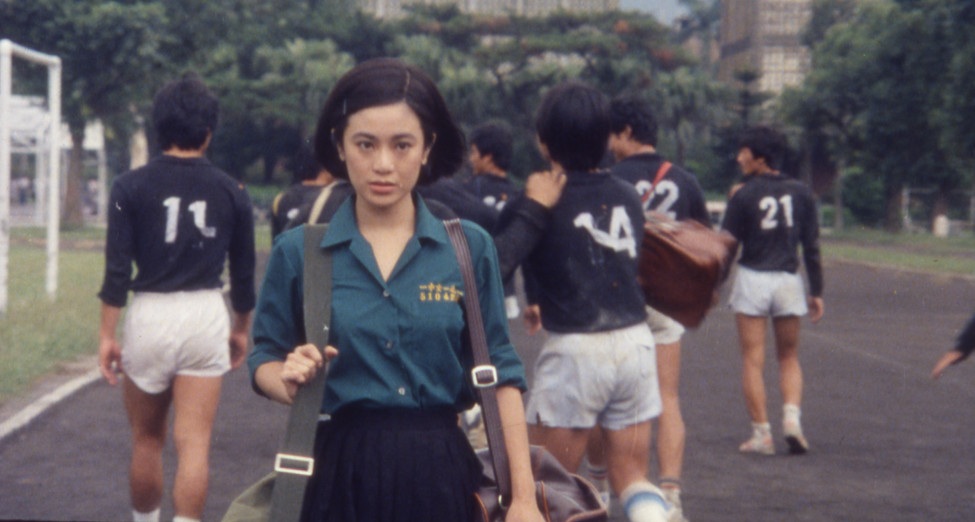
Love and happiness come easily to no one in THAT DAY, ON THE BEACH. Yet the film does not feel entirely tragic. After everything she has been through, Jiali walks away with a steady step, and Weiqing smiles as she watches her go. The camera follows Jiali’s steps in slow motion. Warm sunlight falls on Weiqing’s face. An even greater reason lies in the beauty of the images themselves. THAT DAY, ON THE BEACH was the first feature on which cinematographer Christopher Doyle picked up a 35mm camera. He would later help shape the look of Hong Kong cinema in its heyday. In the daytime scenes, pale pastel colors blend softly together. At times the sunlight spreads gently through the frame, as though a thin curtain had been drawn across the image. A single frame holds that soft spill of light, the contrast between red and green, Jiali’s elegant white clothes, and the grain of the film, which evokes a time gone by. This is how the film finds beauty in the tragic lives of its characters and in the Taiwan they inhabited.
Just as Jiali suddenly loses her husband, the people of Taiwan in the film seem to have lost something amid rapid economic growth and Westernization. Yet the film holds out the hope that looking back might allow them to imagine a slightly different future. Much of the story unfolds in flashback, but it keeps returning to the café where Jiali and Weiqing sit across from each other. Sound connects past and present. We hear Weiqing playing the piano in the present, and the music continues as her younger self heads to the rugby field to see Jiasen. An even more striking moment comes when Jiasen throws a ball after his father has arranged his marriage. The image has already returned to Weiqing listening to Jiali in the café, but we can still hear the ball bounce. It is as though the pain Jiasen felt that day has crossed all those years to reach the woman he once loved. Using sound to bridge a flashback and the present is a familiar technique. In THAT DAY, ON THE BEACH, it allows us to see the faces of people in Taiwan who must carry their past with them into the future.
In a Camerimage interview with Daniel Eagan and fellow cinematographer Jasper Spanning, published in Filmmaker on March 4, 2019, Christopher Doyle recalled THAT DAY, ON THE BEACH as one of Taiwan’s early women’s films. “It was the #Metoo film of that period.” Jiali’s father insists that both his children marry the people he has chosen for them. He also sexually assaults a nurse who works at his clinic. As a child, Jiali sees this happen through the examination room window. Later in life, she encounters a prosperity that feeds everyone’s desires, and she finds it difficult to trust either her husband or her friends completely. “You shouldn’t trust anyone completely. You have to decide for yourself.” It took her brother Jiasen a lifetime to reach that conclusion. Having placed so much trust in his father that he let Weiqing, the one woman he loved, go, he passes those words on to his sister before he dies.
Yet in Jiali’s willingness to look back on a painful past, the film finds the possibility of going on with life after losing the people one holds dear. Its willingness to revisit old wounds through a woman’s eyes and imagine a new life for her is part of what makes THAT DAY, ON THE BEACH a pioneering work of the Taiwan New Wave. The dream that began in this film did not end with the sight of Jiali walking away. In the films that followed, Edward Yang continued to look closely at a changing Taiwan and to ask what its future might hold.
<해탄적일천>, 사라진 사람들, 계속되는 삶
<해탄적일천>(That Day, on the Beach, 1983)은 1980년대 대만의 수도 타이베이에서 사랑과 행복을 찾지 못해 방황하는 사람들을 다룬다. 이들의 삶은 저마다 다른 이유로 비극적이다. 주인공 린자리(실비아 창)는 남편 청더웨이(데이비드 마오)를 잃었다. 남편이 바닷속으로 사라졌는지, 다른 어딘가로 떠났는지는 끝내 의문으로 남는다. 린자리와 13년 만에 다시 만난 탄웨이칭(테리 후)에게도 잃어버린 사람이 있다. 바로 린자리의 오빠이자 탄웨이칭이 한때 사랑했던 린자썬(가오밍훙)이다. 린자썬은 아버지의 뜻에 따라 다른 사람과 결혼했다. 탄웨이칭은 옛 연인이 지난겨울 암으로 세상을 떠났다는 소식을 린자리에게서 뒤늦게 듣는다. 청더웨이의 오랜 친구 아차이(쉬밍)는 청더웨이가 사라진 뒤 회사 자금 5천만 대만달러가 비었다고 말한다. 린자리의 대학 시절 친구 신신(리례)은 여러 남자를 만났지만, 아이의 아버지가 떠난 뒤 홀로 아이를 키우고 있다.
이들의 비극에는 두 가지 사회적 배경이 있다. 하나는 유교적 가부장제이고, 다른 하나는 급속히 성장한 자본주의다. 린자리 남매의 아버지(난쥔)는 대만 남부의 소도시에서 병원을 운영하는 의사다. 그는 두 자녀의 혼처를 직접 정하고 자기 뜻을 따르도록 강요한다. 병원을 겸한 아버지의 집에서는 의사로서 그가 거둔 성공을 엿볼 수 있다. 집 안은 정갈하고 햇빛이 환하게 든다. 그러나 딸 린자리에게 이 아름다운 집은 언젠가 빠져나가야 할 새장이다. 아버지가 정한 결혼을 받아들일 수 없었던 린자리는 한밤중에 집을 나선다. 종이문에 비친 린자리의 그림자가 가느다란 나무 문살 사이를 스쳐 지나간다. 다시 보면 문살에서 바닥까지 격자를 이룬 선들이 집 안에 걸린 새장의 살을 떠올리게 한다.
오빠 린자썬은 동생처럼 도망치지 못했다. 카메라는 새장에 갇힌 듯한 오빠를 담을 때 영화에서 가장 활발하게 움직인다. 린자리가 어머니와 산책을 마치고 돌아올 즈음, 집 밖에 있던 카메라는 벽을 따라 복도를 지나 거실로 들어선다. 바깥과 달리 거실은 어둡다. 오빠는 무릎을 꿇고 있고, 그 앞에는 아버지가 집어던진 듯한 그릇 조각들이 흩어져 있다. 거실로 들어온 어머니는 집안의 하녀처럼 말없이 그 조각들을 줍는다. 카메라는 다시 왼쪽으로 움직여 복도에 선 린자리를 비춘다. 린자리는 거실로 들어가지도, 집 밖으로 나가지도 못한 채 그 광경을 지켜본다. 바로 다음 쇼트에서 카메라는 거실에서 한층 더 물러난다. 오빠는 여전히 아버지 앞에 무릎을 꿇고 있다. 화면 전경에는 묵직한 나무 세 그루가 서 있고, 오른편에는 새장이 쓸쓸히 걸려 있다. 결국 오빠는 원치 않는 사람과 결혼했고, 아버지의 뜻을 따른 그날의 선택을 평생 후회했다.
새장을 벗어난 린자리는 오빠와 다른 삶을 사는 듯했다. 그러나 린자리를 기다리는 것은 급격한 자본주의 성장이 가져온 또 다른 고통이었다. 집을 나온 린자리는 대학 시절 사랑했던 청더웨이와 결혼한다. 가진 것 없는 두 사람이 서둘러 혼인 신고를 할 때, 린자리는 남편의 손을 꼭 잡는다. 맞잡은 두 손의 클로즈업에는 린자리가 꿈꾸던 행복이 담겨 있다. 남편 청더웨이는 곧 친구 아차이의 회사에서 사업을 총괄하며 바쁜 나날을 보낸다. 그는 타이중 현장을 살펴보러 간다며 밤에 차를 몰고 떠난다. 훗날 린자리는 남편이 일본에 다녀온 일조차 다른 사람에게서 듣는다. 남편이 집을 비우는 날이 잦아지자 린자리는 그가 다른 여자를 만나는 것은 아닌지 전전긍긍한다. 남편 역시 불안에 지친 아내의 모습에서 결혼 생활의 균열을 본다. 이들 부부가 타이베이에서 새로 이사한 아파트의 현관문을 눈여겨볼 만하다. 굵은 쇠창살이 수직으로 뻗어 있고, 그 사이로 사각형 무늬가 반복된다. 린자리는 그 문을 열고 또 하나의 새장으로 들어간 셈이다.
타이베이, 아니 대만 전체가 하나의 새장인지도 모른다고 영화는 말한다. 당시의 표현을 빌리자면 대만은 한국, 홍콩, 싱가포르와 함께 ‘아시아의 네 마리 용’으로 불릴 만큼 경제 성장을 이뤘다. 그러나 린자리의 아버지가 보여주듯 가부장제의 그늘은 여전히 짙었다. 클래식 음악과 럭비, 메르세데스-벤츠와 서구식 정장, 드레스와 댄스 바가 인물들의 일상에 들어왔지만, 그 풍요가 이들을 행복하게 해주지는 못했다. 린자리는 남편과의 관계를 회복해 보려 함께 드라이브에 나선다. 빠르고 민첩한 차는 남편의 난폭한 운전을 가능하게 할 뿐이다. 화가 난 린자리는 백화점에서 값비싼 물건을 한 아름 사들인다. 집에 돌아오니 방 안은 이미 어둠에 잠겨 있다. 그 어둠 속에서 새로 산 물건들의 화려함은 갈 곳을 잃는다. 린자리는 댄스 바와 카페에서 핑핑(우사오강)이라는 남자와도 만난다. “유럽, 남미, 중동, 인도와 네팔…” 핑핑은 자신이 여행한 곳을 줄줄이 댄다. 그 많은 이야기를 듣고도 린자리는 핑핑이 어떤 사람인지 설명하려다 말끝을 흐린다. “무슨 일을 하는지 잘 모르겠는.” 핑핑을 향했던 린자리의 호기심은 끝내 의문으로 남는다.
<해탄적일천>은 그 누구에게도 사랑과 행복을 쉽사리 허락하지 않는다. 그런데도 이 영화가 마냥 비극적으로 보이지는 않는다. 온갖 일을 겪고도 당당히 걸어가는 린자리와 그 뒷모습을 미소 지으며 바라보는 탄웨이칭이 있기 때문이다. 카메라는 린자리의 걸음을 슬로 모션으로 담는다. 그 모습을 지켜보는 탄웨이칭의 얼굴에는 따스한 햇빛이 비친다. 더 큰 이유는 영화의 영상 자체가 아름답다는 데 있다. 훗날 홍콩 영화의 전성기를 이끈 촬영감독 크리스토퍼 도일이 처음으로 35mm 카메라를 잡은 장편이 바로 <해탄적일천>이다. 낮 장면에서는 옅은 파스텔 톤의 색들이 부드럽게 어우러진다. 때로는 햇빛이 주변으로 은은하게 번져 화면에 아주 얇은 커튼을 한 겹 드리운 듯하다. 이 부드러운 빛 번짐과 빨강과 초록의 대비, 린자리의 우아한 흰옷과 향수를 불러일으키는 필름 그레인이 한 화면에 담긴다. 그렇게 영화는 인물들의 비극적인 삶과 그들이 살아간 대만의 풍경을 아름답게 담아낸다.
린자리가 어느 날 갑자기 남편을 잃었듯, 영화 속 대만 사람들도 급격한 경제 발전과 서구화의 물결 속에서 무언가를 잃어버린 듯하다. 그럼에도 영화에는 지난 일을 되짚어보며 앞으로의 삶을 조금은 다르게 상상할 수 있으리라는 낙관이 있다. 영화의 상당 부분은 회상으로 이뤄져 있지만, 이야기는 린자리와 탄웨이칭이 마주 앉은 카페로 종종 돌아온다. 그때마다 과거와 현재를 잇는 것은 소리다. 현재의 탄웨이칭이 연주하는 피아노 소리는 과거의 탄웨이칭이 럭비를 하는 연인 린자썬을 만나러 운동장으로 가는 장면까지 이어진다. 더 인상적인 순간은 아버지의 뜻대로 혼사가 정해진 린자썬이 공을 던질 때다. 화면은 어느새 카페에서 린자리의 이야기를 듣는 탄웨이칭을 비추는데, 공이 튀는 소리는 여전히 들린다. 마치 그날 린자썬이 겪은 고통이 오랜 세월을 건너 옛 연인에게 고스란히 가닿는 듯하다. 소리로 회상 장면과 현재를 잇는 것은 익숙한 영화 문법이다. <해탄적일천>은 그 문법으로 과거를 품은 채 미래를 살아가야 하는 대만 사람들의 얼굴을 보여준다.
촬영감독 크리스토퍼 도일은 훗날 〈해탄적일천〉이 대만의 초기 여성영화 가운데 하나이자 “그 시대의 미투 영화”였다고 회고했다(대니얼 이건, 「“영화는 단 한 편이에요. 그 제목이 바로 당신의 삶이죠”―카메리마주에서 만난 촬영감독 크리스토퍼 도일과 야스페르 스패닝」, 《필름메이커》, 2019년 3월 4일). 린자리의 아버지는 두 자녀에게 자신이 정한 상대와 결혼하라고 강요했다. 그는 병원에서 함께 일하던 간호사도 성추행했다. 어린 린자리는 진료실 창밖에서 그 장면을 목격한다. 훗날 린자리가 마주한 자본주의적 풍요는 개개인의 욕망을 키웠고, 그 속에서 린자리는 남편도 친구도 온전히 믿기 어려워졌다. “누구를 완전히 믿어선 안 되며 자신이 결정해야된다”는 말은 오빠 린자썬이 평생에 걸쳐 얻은 결론이었다. 아버지를 너무 믿은 나머지 유일한 사랑이었던 탄웨이칭을 떠나보낸 오빠가 죽기 전 동생에게 들려준 말이다.
그럼에도 영화는 고통스러운 과거를 돌아보는 린자리의 모습에서 소중한 사람들을 잃은 뒤에도 자신의 삶을 이어갈 가능성을 찾는다. 과거의 상처를 여성의 시선으로 돌아보고 새로운 삶을 모색하려는 태도는 〈해탄적일천〉을 대만 뉴웨이브의 선구적인 여성 서사로 만든 힘이기도 하다. 이 영화에서 시작된 꿈은 린자리의 뒷모습에서 끝나지 않았다. 에드워드 양 역시 이후의 영화들을 통해 변화하는 대만의 현실을 응시하며 그 미래를 물었다.
The HIFF ONLINE CREATIVES & CRITICS IMMERSIVE (HOCCI) program supports sustainable film criticism in Hawai’i through mentorship and paid career opportunities for Hawai’i-based AANHPI critics. The mission of HOCCI is to broaden diversity in film criticism across the Pacific and use influencer branding strategies to spark career opportunities. The 2026 HOCCI is supported by Critical Minded, a grant-making and learning initiative that supports cultural critics of color in the United States.
 Junseok Eom began his career in South Korea as a film critic, festival programmer, and video producer.He served as a jury member at the Busan International Short Film Festival and as Program Director for the Busan International Kids and Youth Film Festival. Eom wrote film criticism for Cultura and has contributed film-related articles to Kyungsang Ilbo since 2026. After moving to the U.S., he produced digital content for NRDC, an environmental advocacy organization. He currently works at KBFD-TV in Hawai‘i as a news video editor and commercial/documentary producer, while expanding his work in U.S. film criticism and festivals