

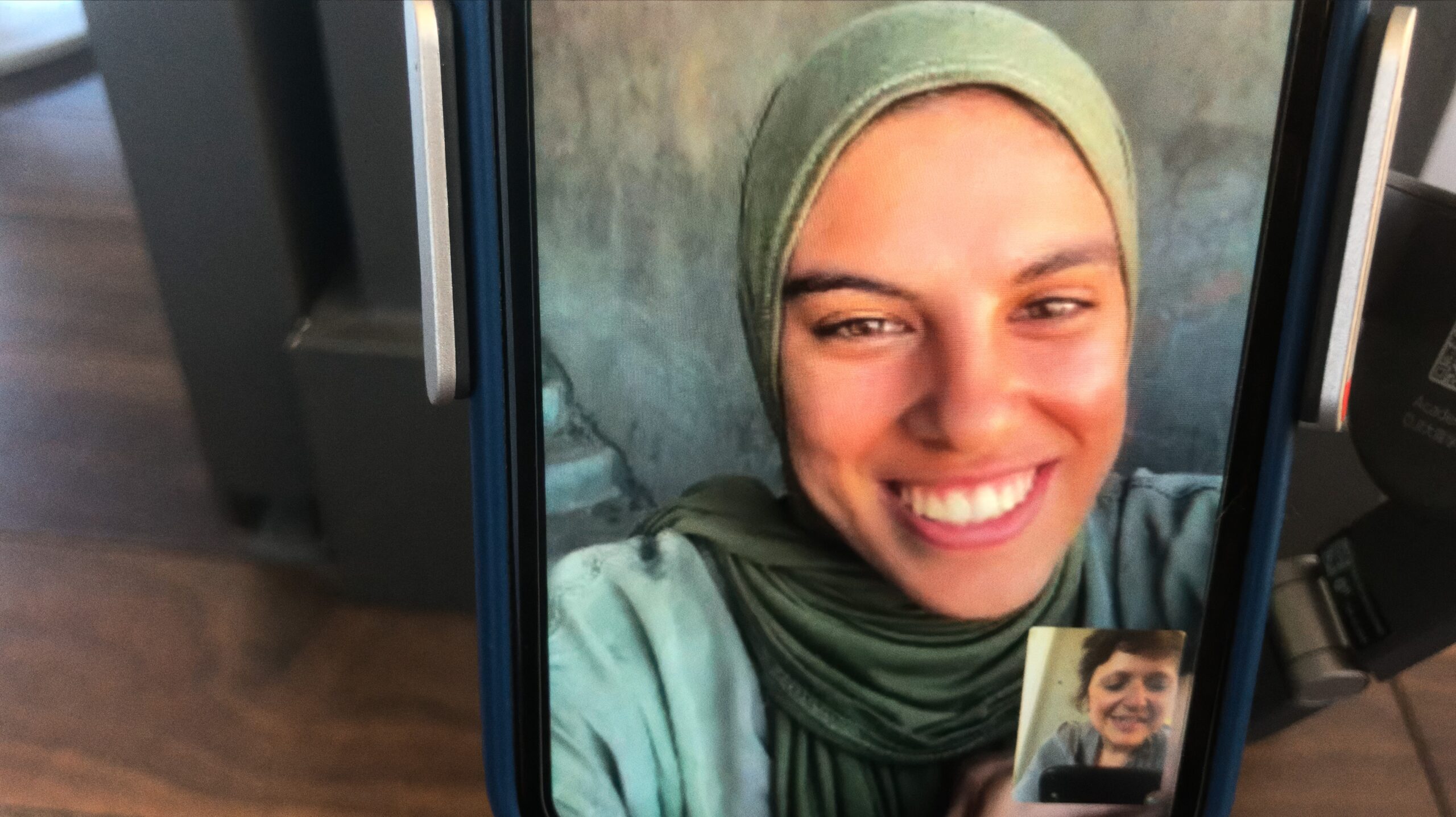
PUT YOUR SOUL ON YOUR HAND AND WALK premiered at the 45th Hawai’i International Film Festival presented by Halekulani.
Over the past two years, during Israel’s most recent genocidal campaign against the people of Gaza, more than 67,000 Palestinians have been killed by the Israeli military, and 170,000 have been wounded, with 40,000 of those wounded having life-altering injuries, according to Gaza’s Health Ministry. These are severely underestimated counts that do not include the thousands of people believed buried under rubble. Gaza has become an open-air prison, with almost all of its 2.3 million inhabitants having lost their homes to Israeli bombardment. After October 10, 2025, when the US brokered another fragile ceasefire deal between Israel and Hamas, the Israeli military continued to launch disproportionate waves of airstrikes on Gaza. Israel and Hamas are continuing to release hostages and detainees, and a fraction of obligated aid is being delivered by Israel to Gazan families, as hunger persists and winter is approaching.
This is the reality that continues after PUT YOUR SOUL ON YOUR HAND AND WALK, a documentary directed by the Iranian filmmaker Sepideh Farsi that follows Fatma Hassona, a 25-year-old photojournalist and artist living under siege in Gaza. Fatma’s presence emerges largely through a series of WhatsApp calls spanning from April 2024 to her death on April 15, 2025. Israel’s onslaught in Gaza is the first live-streamed genocide, violence that we see unfolding every day on our phones. This digital proximity enables Farsi to film her correspondence with Fatma as she and her family secure shelter, food, and aid across Gaza. Still, within the documentary, levels of distance separate the two women. Farsi uses a handheld camera to record her phone’s WhatsApp calls with Fatma, contending with fragile internet connectivity and language barriers. This framing device reflects the privileges of Farsi’s own filmmaking environment in contrast to Fatma’s life in Gaza, negotiating between intimacy and separation.
PUT YOUR SOUL ON YOUR HAND AND WALK asks us to position ourselves against genocide, not only as witnesses to the documentary, but as people who live lives outside film festivals and movie theaters, in response to the world as it presently is. In RECOGNIZING THE STRANGER: ON PALESTINE AND NARRATIVE, the British Palestinian author Isabella Hammad offers a path, “We who are not there, witnessing from afar, in what ways are we mutilating ourselves when we dissociate to cope? To remain human at this juncture is to remain in agony. Let us remain there: it is the more honest place from which to speak.” To remain in agony is to dwell in suffering long enough for it to reorder how we move through the world. It requires turning inward and holding ache, and turning outward to disrupt the systems that condition our denial of genocide.
The title, PUT YOUR SOUL ON YOUR HAND AND WALK, is Fatma’s poetic articulation of the intrepidness and vulnerability required when moving from one place to another in Gaza. To document life in Gaza is to risk one’s life with openheartedness. Fatma’s persistent correspondence with Farsi about her survival in Gaza is punctuated by interludes of Fatma’s photography, poetry, and songs, where her openheartedness is most palpable. In “The Man Who Wore His Eyes,” one of Fatma’s poems featured, she writes, “I do not have a story / One clear for a stranger / To believe it.” Fatma calls out the world’s refusal to recognize Palestine, and although she didn’t see the film, I wonder if she believed in its potential to spur recognition. She speaks frequently of her inability to reach the world beyond Gaza, telling Farsi, “My eyes have seen so much yet so little,” yet she widens the eyes of the world. Such spectatorship implicates us in a choice to recognize Fatma, but it also places the burden of proof onto Palestinians to make their humanity legible. How much of this dynamic can we change?
Farsi situates us in the ethical murkiness of documenting genocide through Fatma’s intimate and precarious first-hand account. A significant part of the conflict is control over imagery, as the Israeli military has killed around 250 Palestinian journalists over the last two years, and Israeli authorities continue to bar foreign journalists from entering Gaza. Western media, which conventionally platforms singular protagonists, continues to route our understanding of atrocity through the lens of individuals, rather than the systems that make mass violence possible. How does documentation determine who we grieve and mourn? Each act of visual framing constrains our window of knowledge and judgement. What is lost in the moment a documentary transforms from an act of documentation to an act of interpretation? Is the threshold of recognition that precariousness can never be wholly recognized?
On April 16, 2025, Fatma and six members of her family were murdered by an Israeli airstrike that hit her home in northern Gaza, transforming PUT YOUR SOUL ON YOUR HAND AND WALK into an epitaph. A report released in May from Forensic Architecture concludes that the Israeli military premeditated the murder of Fatma and her relatives. Upon their death, Farsi kept the documentary’s structure largely the same to reflect the events’ chronology. During their final call, Farsi informs Fatma that the film will have its world premiere at the Cannes Film Festival, to which Fatma replies that she hopes to attend. They discuss arranging Fatma’s passport. After their call, Farsi added a final caption that Israeli airstrikes murdered the Hassouna family, recontextualizing their correspondence as a record of the last year of Fatma’s life. In becoming an elegy, the film reveals the critical distance and moral evasions that structure its reception.
To write about PUT YOUR SOUL ON YOUR HAND AND WALK is to write against how the language of cultural production renders genocide legible only as an issue of the documentary. Recent articles on the documentary, since its theatrical release in New York on November 5th, have underscored the constraints of film criticism in meaningfully positioning ourselves to the ongoing genocide in Gaza. The lede in a review in The Guardian functions by calling the death of Fatma the “big reveal” of the documentary, and another review by the New York Times tames its first description of Gaza City as having “rough conditions,” and largely omits the Israeli government and military as actors of disproportionate violence in Gaza. A recent review in Vulture underscores the film’s core of helplessness, characterizing audience members as people who “can see everything and change nothing,” but such a description elides our reality as participants in countries and systems that have perpetuated the ongoing genocide, and forecloses the opportunity for us to think critically of such participation.
The institutions that mediate how we encounter films, such as festivals, foundations, and publications, are not neutral. Over the past two years, the Hawai’i International Film Festival has partnered with The Asian American Foundation, an organization affiliated with the Anti-Defamation League, which, under the window-dressing of civil rights advocacy, has a historic record of legitimizing right-wing repression against Black, immigrant, queer, Muslim, Arab, and other marginalized communities. Although TAAF has funded important Asian American and Pacific Islander causes as a philanthropic organization, it has achieved its agenda with the backing of Jonathan Greenblatt, who, with the ADL, has attacked Muslim and Jewish activists and student organizations and spread disinformation campaigns to criminalize pro-Palestinian and anti-Zionist protestors. Despite months of public pressure to remove him from the TAAF board, Greenblatt completed his three-year term on TAAF’s Board of Directors. In July 2024, he was replaced by Geraldine Acuña-Sunshine, another ADL board member, further affirming what TAAF calls its “strategic relationship” with the ADL.
HIFF’s continued sponsorship arrangement with TAAF appears at odds with its own stated mission to champion Native Hawaiian and global Indigenous filmmakers, many of whom use cinema to explore issues of racial, economic, and environmental justice. During HIFF44 in October 2024, film workers from Hawaiʻi published an open letter urging HIFF to ask TAAF to end its partnership with the ADL and to remove ADL-affiliated leadership from its ranks. Nearly one hundred artists, filmmakers, cultural workers, and audience members connected to HIFF or Asia-Pacific cinema signed the letter and requested a public response by the final day of the festival, November 10, 2024. More than a year later, HIFF has not publicly addressed or responded to the concerns raised. For HIFF45, TAAF again appeared as one of the festival’s major sponsors.
When asked by Variety about the separation between film festivals and current politics, Farsi responds, “How can you separate politics from life, and who draws that line?” In recent years, HIFF’s educational program has flourished because of its commitment to teaching Hawai’i students about cinema as a political tool. In contrast, HIFF’s silence regarding its sponsorship with TAAF creates a separation between cinema and politics, and points to a larger Western attitude of neutrality and inactivity amid genocide. The open letter confronts the ideological contradictions of HIFF’s operation as a corporation, when financial decisions work against the values of the films it programs. Calling upon TAAF to cease its relationship with the ADL is also a demand for HIFF to join the effort of filmmakers worldwide to organize in response to genocide. It’s the stated demand because it is achievable, and because it pushes HIFF toward imagining cinema unbound from commercial interests.
Film cannot unilaterally change the world, because works of art don’t act on their own. Cultural production is just one of many sites of resistance. It’s dangerously easy to say that films are politically useless, to doubt their ability to hold our attention, and to question what exactly being affected by a film means beyond catharsis, if even that. In the hour of genocide, PUT YOUR SOUL ON YOUR HAND AND WALK shows us that cinema’s value might rest in interrogating its own political limits, thereby moving us to take action beyond them.
The HIFF ONLINE CREATIVES & CRITICS IMMERSIVE (HOCCI) program supports sustainable film criticism in Hawai’i through mentorship and paid career opportunities for Hawai’i-based AANHPI critics. The mission of HOCCI is to broaden diversity in film criticism across the Pacific and use influencer branding strategies to spark career opportunities. The 2025 HOCCI is supported by Critical Minded, a grant-making and learning initiative that supports cultural critics of color in the United States.
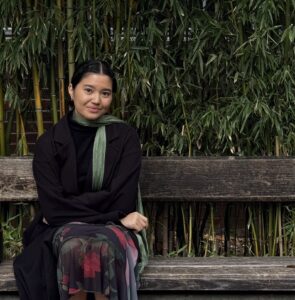
Connor Arakaki is a Native Hawaiian journalist and screenwriter studying at Yale University, where she previously served as the editor in chief of the Yale Herald. You can find her words in The Nation, DIAGRAM, The New Journal, Hawai‘i News Now, and elsewhere. She is committed to accountability-driven writing that platforms Indigenous voices and those often underrepresented in traditional media and criticism. She is currently working on a screenplay titled DISORIENTATION, which traces the lives of two Native Hawaiian students as they unravel the founding history of their university during the first week of classes.