

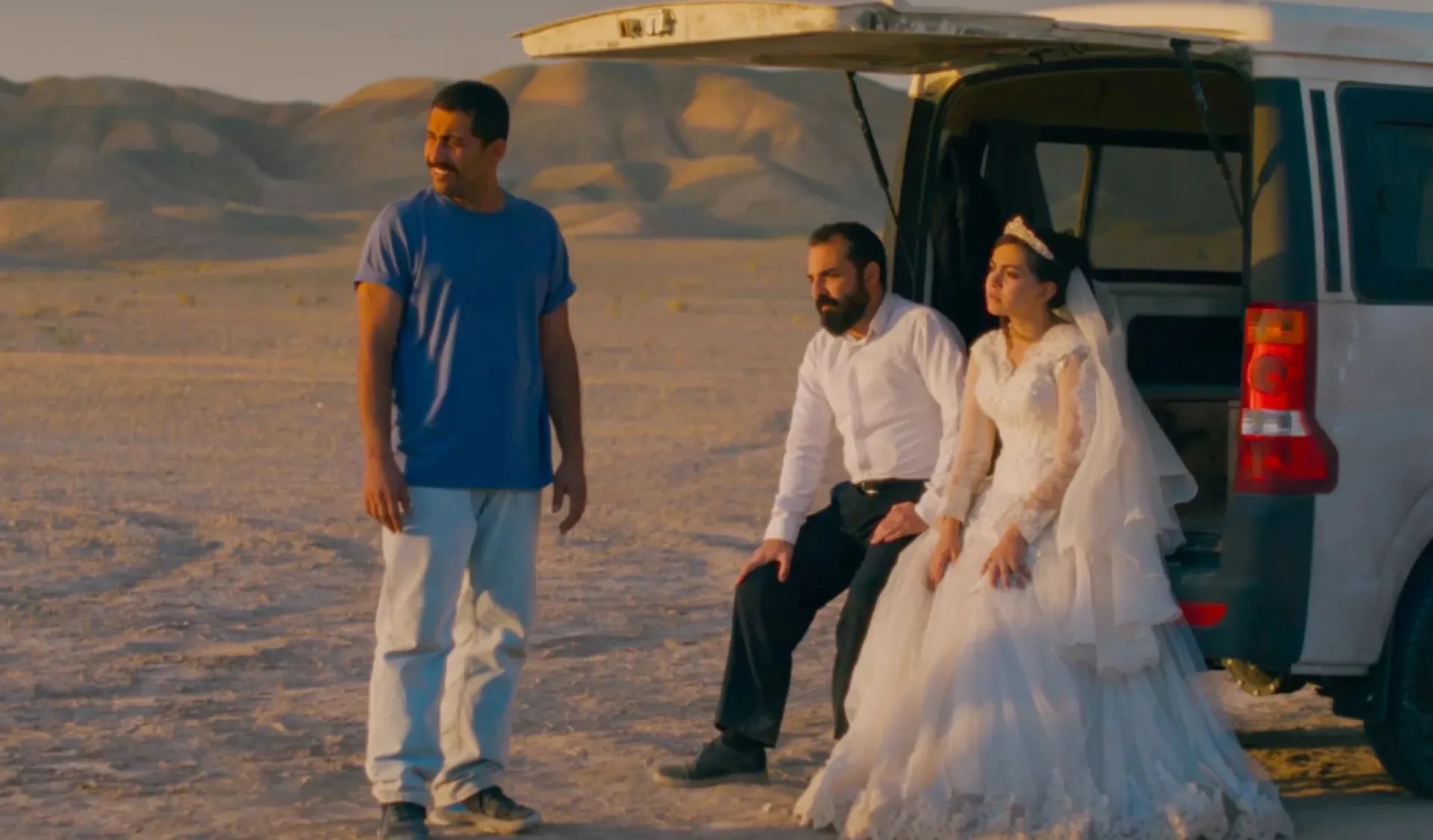
IT WAS JUST AN ACCIDENT premiered at the 45th Hawai’i International Film Festival presented by Halekulani.
A decade ago, the Iranian director Jafar Panahi converted a taxi cab into a portable movie studio, relying on a dashboard-mounted camera to clandestinely record his encounters with passengers while he passed as an ordinary driver in Tehran’s dense traffic. From that experiment emerged TAXI (2015), the third film he released since he was sentenced to prison and banned by the government from filmmaking, interviewing, and traveling outside the country. One of his friendliest passengers in the film is a red-haired woman carrying a bouquet of red roses, but when she enters, Panahi is shaken. After some time and trust-building, he confesses, “I heard a voice right before I saw you. I thought I recognized my interrogator.” She, too, carries the memory of Iran’s prisons. Nasrin Sotoudeh, the human rights lawyer, had only recently been released and is on her way to visit a prisoner on a hunger strike. In haunting recognition, Sotoudeh replies, “Many of my clients say the same thing. They want to identify people from their voices. It’s the advantage of blindfolds.”
What began as a fleeting exchange with Sotoudeh in TAXI, perhaps all this time, was quietly brewing into a larger and more furious story, Panahi’s latest film, IT WAS JUST AN ACCIDENT (2025). The political thriller, which won the Palme d’Or at the Cannes Film Festival, follows an auto-repair man, Vahid (Vahid Mobasseri), who kidnaps a client, Eghbal (Ebrahaim Azizi), out of suspicion that he was an interrogator who tortured him in an Iranian prison while blindfolded. Vahid recognizes Eghbal by his voice and the squeak of his prosthetic leg, but part of him is uncertain. To confirm Eghbal’s identity, Vahid recruits other surviving political prisoners, the wedding photographer Shiva (Maryam Afshari), soon-to-be husband Ali (Majid Panahi), and wife Goli (Hadis Pakbaten), and his own former cellmate and Shiva’s ex, Hamid (Mohamad Ali Elyasmehr). On an elliptical road adventure, with Eghbal stashed in the back of a van, Vahid and his companions reckon with how to punish someone for crimes vicious and unspeakable.
Beneath the question of Eghbal’s identity lies the deeper debate of whether violence or nonviolence is the path towards restitution, and it’s this fraught calculus of justice that drives the film. Eghbal, nicknamed “Peg Leg” and “The Gimp” in prison, pulls the group back into the memories of their imprisonment through different senses—Shiva recognizes him by smell, and Hamid, by the texture of his amputated leg—but the shock of that sensory reminder doesn’t bring clarity, so much as it reignites their trauma and their desire for violence. Hamid, seething with rage, is ready to kill Eghbal the moment he sees him, but Shiva and Vahid demand an undisputable identification first, while Goli refuses to be roped back into her trauma and wants only to proceed with her new life in marrying Ali. In these circumstances, all of the former prisoners’ tactics are truly reasonable, and right when the impasse reaches its most muddled point, Eghbal’s phone rings. His daughter (Delmaz Najafi) pleads to the group that her pregnant mother (Afssaneh Najmabadi) has fainted and needs to be taken to a hospital immediately, adding another layer of collateral damage for the group to manage.
As the group splinters, Panahi exposes the moral disorder of combating authoritarian rule, and keeps the film sharply uninterested in proving the legitimacy of vengeance. Frustrated after taking Eghbal’s daughter and wife to the hospital, where his newborn son is delivered (and begrudgingly celebrated by the group with gifted sweets), Hamid, Goli, and Ali decide they can no longer justify continuing. Pushed to the brink of retaliation, Vahid and Shiva blindfold Eghbal and tie him to a tree in the final act of the film, conceding to replicating their own conditions of torture. The red glow of the van’s taillights indicts Eghbal, recalling the film’s opening (and titular) scene when he exits his car to discover he has accidentally hit a dog while driving. At the film’s climax, Panahi lingers in an unbroken midshot that excludes Vahid and Shiva from our view as they interrogate the blindfolded Eghbal, forcing us to inhabit his denial of being the man they seek until his guilty admission.
From personal persecution and the testimony of other political prisoners, Panahi, in his repeated cinematic stealth, made IT WAS JUST AN ACCIDENT (2025) for the people of Iran at their current political moment of authoritarianism. Yet, the film is a strikingly universal story about how to proceed after oppression, when survival demands a forward progression, but grief has its own repetitive appetites. Especially in an American context, the film reminded me of the truths of coalition-building, of its ugly negotiations and compromises when trying to seek justice collectively. Panahi seems to argue that the fulfillment of vengeance is futile and short-sighted because authoritarianism is embedded in systems that outlive individuals. Yet, we still have a responsibility to others. Oppression and its memories will remain undigested without recognition, but Panahi proposes that instead of seeking recognition from perpetrators, we should look to one another.
The HIFF ONLINE CREATIVES & CRITICS IMMERSIVE (HOCCI) program supports sustainable film criticism in Hawai’i through mentorship and paid career opportunities for Hawai’i-based AANHPI critics. The mission of HOCCI is to broaden diversity in film criticism across the Pacific and use influencer branding strategies to spark career opportunities. The 2025 HOCCI is supported by Critical Minded, a grant-making and learning initiative that supports cultural critics of color in the United States.
Connor Arakaki is a Native Hawaiian journalist and screenwriter studying at Yale University, where she previously served as the editor in chief of the Yale Herald. You can find her words in The Nation, DIAGRAM, The New Journal, Hawai‘i News Now, and elsewhere. She is committed to accountability-driven writing that platforms Indigenous voices and those often underrepresented in traditional media and criticism. She is currently working on a screenplay titled DISORIENTATION, which traces the lives of two Native Hawaiian students as they unravel the founding history of their university during the first week of classes.