

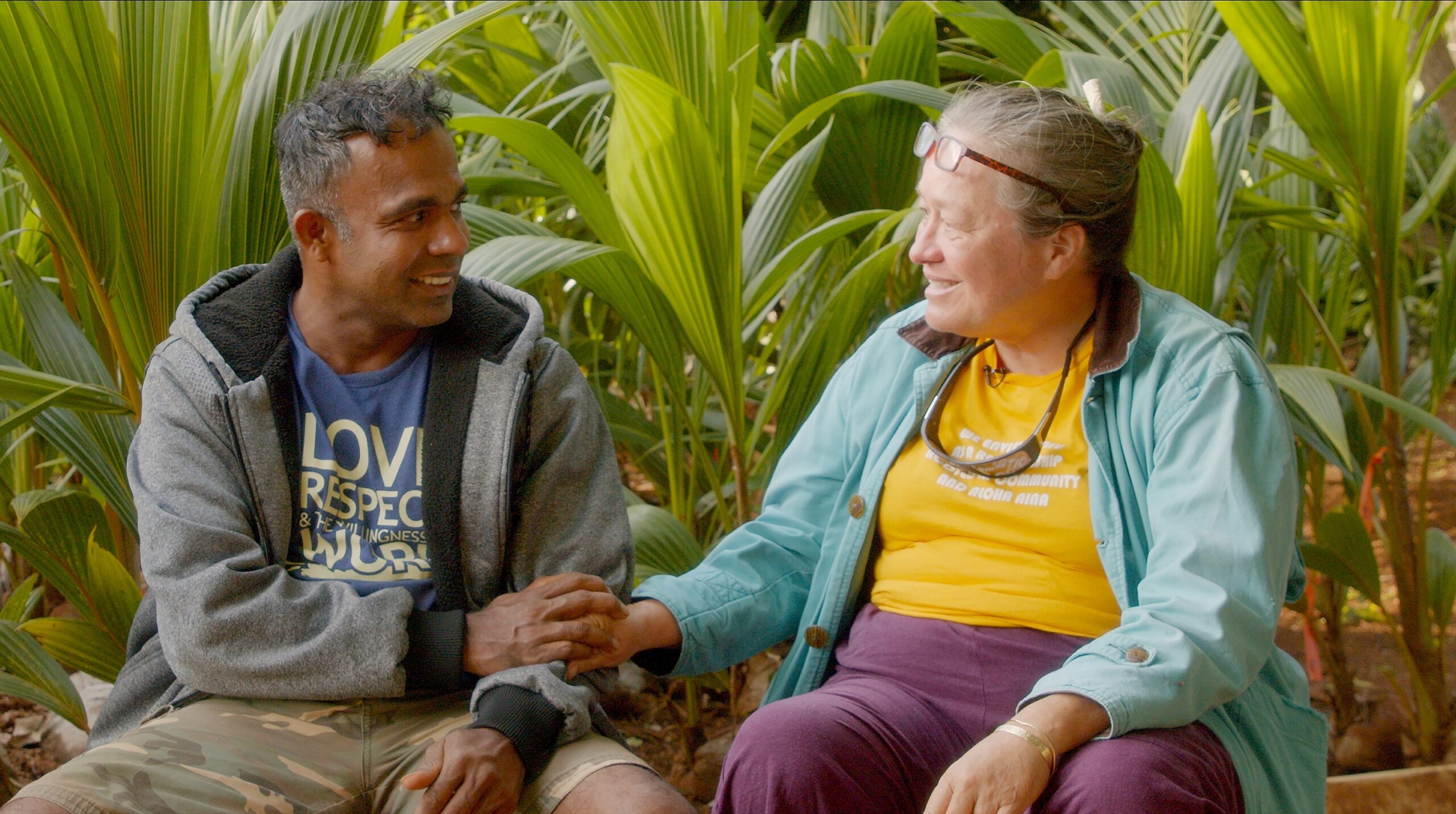
Alex Cantatore is the director, producer, and co-editor of the feature documentary NIU FOREVER, which made its debut at HIFF46. The film continues the story from Alex’s 2021 short film Kumu Niu, which won the 2022 award for Best Environmental Short Film at HIFF. It follows the people behind Niu Now, a grassroots organization dedicated to the preservation and revival of culturally appropriate coconut tree (niu) cultivation in Hawai’i, including cultural advisor and educator Dr. Manulani (Manu) Aluli Meyer, niu cultivation master Indrajit Gunasekara and his protege Jesse Mikasobe-Kealiinohomoku, a former student at UH West Oahu who hails proudly from Waianae. Over the span of a few years, we see Niu Now’s work in educating communities about planting uluniu (coconut groves) and working on reviving the cultivation of coconuts in Hawai’i, as well as dealing with the ongoing major threat of the coconut rhinoceros beetle. Alex and his partner Megan were the first filmmakers I met at HIFF this year and we gradually built a rapport over the course of the festival. Alex and I met in Nu’uanu Valley a few hours before his Kapolei-side screening to discuss the documentary.
Jordan Nakamura: First, congratulations on the premiere! How has it been attending HIFF again? What have you been up to thatʻs been a highlight this time?
Alex Cantatore: So this past Saturday we attended a workday for Niu Now. Quickly, to preface all this, I first came here to Oahu with my friend and our cinematographer, Nathan Alexander to shoot the short film in 2021. The sort of climax of that first film revolved around the final planting
day of the first uluniu (or coconut grove) at UH West Oahu. Our poster image for that film is of this little keiki niu that’s maybe 2 feet high. Itʻs been amazing throughout the years to come back here and see that tree grow up. To see it through its struggles with coconut rhinoceros beetle (CRB) and everything. Itʻs been attacked several times, there’s tons of netting on it, but it survived! And now it’s over 20 feet tall.
When we finished shooting Kumu Niu, Nate and I were talking and we really said there’s such a bigger story here. We were only here for a week, and the work we are talking about here takes generations. One of the things Aunty Manu talked about at that time was, you know, in 5 to 7 years we are gonna have coconuts on these trees.
And so, this past Saturday, we didn’t know this was going to happen but what they had scheduled for us to plant were actually the first seeds from those coconut trees in that uluniu we filmed 5 years ago.
JN: No way! Wow, that’s amazing to come full circle like that.
AC: This was the first time they were able to plant that second generation of niu from that grove and it was totally moving. Like I was crying so much!
JN: It’s hard to describe that feeling when you realize, oh yeah, this thing that I’m doing with and within ʻĀina is a relationship as much as a family relationship. And you get these emotions toward the land that you might feel in healthy family gatherings, watching those milestones happen.
AC: Yeah totally. And you know, Aunty Manu is so eloquent when she talks about these things, and I’ve spent hours and hours of my life at this point listening to her talk about them. But it’s different when you have the continuity of time to be able to see that and embody that. It’s like intellectual wisdom vs experiential wisdom.
JN: How did you first become interested in coconuts? Specifically the revival of niu cultivation in Hawai’i?
AC: There’s the logistical story and then there’s like… the energetic story. I read an article, I think it was in the UH West Oahu newsletter or one of the local papers when they were planting that first grove, and it had just a few quotes in it from Aunty Manu and Indrajit… and it just called to me. You could feel the love and the care for community and the investment in— Aunty Manu calls it “mutual emergence.” Like, we are coming together to do something that is raising our level of consciousness together. One of my favorite lines that made it into the film from her is “we think it’s about the coconuts, but really it’s about the care for each other.” And that came through the first time I read her words in that piece.
The logistical story is that I was doing some nonprofit client work on the continent and pitched them an idea about doing stories about trees in different parts of the U.S. and people’s connections with trees. They wanted to do some work in Hawai’i and originally we were looking to do a story on ulu. But I hadn’t realized ulu had already kind of had its, like, cultural revolution in coming back as a native food source. But we were very lucky to have a friend from the Kaulunani Urban and Community Forestry division, Heather McMillan, who said, “I know you wanna do something about ulu, but I really think you should check out these coconut guys, they are doing something really special.” With that sort of endorsement from Heather, we were able to basically just cold email Aunty Manu and started chatting.
A big thing for me as a filmmaker on this journey has been allowing myself and ourselves as storytellers to become part of the story, to become part of the movement. That was something I really resisted for a long time because I’m not from here. But the love that we’ve been shown and the love that we’ve received… it would be impossible for us to do this from some kind of “objective” standpoint. That’s been one of the issues with documentary filmmaking, or filmmakers approaching other cultures over the decades: that if you try to just stand back and only look at people through your own cultural lens without your own involvement, you’re only gonna get a very small and skewed part of the story.
JN: Yeah it did feel to me that the film was steeped in real relationships. I’ve heard other documentary filmmakers talk about problems inherent in the genre which can be this colonial lens, this distant explanatory posture. For you, were there strategies you thought about when
approaching those anxieties about being an outsider wanting to give due respect, and also those problems with the documentary form?
AC: I think our approach is just, kindness. Humility. Asking and being willing to hear No as an answer.
You know, personality-wise I am often such a people pleaser that I won’t ask questions because I’m afraid the answer will be “no.” That’s something I struggled with in the beginning, and it did happen, people saying no. But I learned at times it was because I wasn’t making it clear what we were trying to capture or show, because I wasn’t asking for what I really wanted. But as we all got to know each other better, I got more comfortable with that, and I think the Niu Now folks and everyone we were working with got more excited about the storytelling themselves. We put out pieces of the film as we were going because we had a whole crowdfunding campaign. There was this live feedback loop, and we were always checking with them about accuracy and if they were liking what was being presented. Eventually, Indrajit would call me up and say “hey this thing is happening, I think you guys should think about coming back and documenting this!”
JN: Thereʻs so much care required with this story: it’s almost like approaching a triage situation. It reminded me of Papa Mau Piailug, the Micronesian navigator who helped revive the art of wayfinding in Hawai’i, and these different island nations interacting— the parallels of these figures who appear and help with the preservation of ancestral practices during a critical time when they are threatened with disappearing entirely.
What does it feel like to be a witness to cultural exchange and this kind of global collaboration?
AC: Yeah, that’s an analogy that came up a few times during filming. I think it didn’t make it into the film because that’s a whole different story to tell, but certainly Jesse and Aunty Manu have referred to Indrajit as sort of the Papa Mau of the Niu movement. And learning more about the culture and understanding that story better, like, that’s huge you know? What an honor to have that comparison being made.
For me, again, it’s about the collaboration that comes together as a result of an energy on a deeper level than anything that may seem to divide us on the surface. Indrajit being from Sri Lanka all the way in the Indian Ocean across the world, but which is also part of this tropical region they refer to as the Coconut Belt. There’s the connection to and love of land and care for
community that’s held in common. For myself, as far as I know, I have no ancestral connection to anywhere that cultivated coconuts, but I recognize the kumu niu as a land ancestor that has brought us together to access this love that allows that cross-cultural collaboration.
JN: What were some things that surprised you during the making of this documentary?
AC: Iʻll say, initially, I thought we were gonna shoot this in a year and edit it in 6 months. (laughs) It took over 4 years!
But to bring in wisdom from Aunty Manu, she says to be steady at something, and give that to the world. This was really a lesson in that, because this is a pretty scrappy crew. It was really like, about 3 of us who were on it for the bulk of it. And not having produced a feature before I
was not very well prepared for the process of dealing with grants and pulling together the funding, like we were building the plane as we were flying it. And we were only able to because of the help of a lot of people who just stepped in at critical moments.
Justin Pascua is a perfect example, he was one of our editors and also did a lot of shooting after principal photography. We first met him just after he graduated from UH Manoa and he came on as a P.A. for a day or two, but we came to find out he had all this camera knowledge and could edit. So we were all here one of those days and our cinematographer Nate got COVID and he couldnʻt finish the shoot so I looked at Justin, like, okay… youʻre the guy! And he did a great job.
JN: It’s great when you can feel this immediate trust and support from a team to where you can just improvise like that. Those relationship dynamics felt really palpably healthy to me just coming from the film and also meeting you all throughout the festival, that there’s real love here.
AC: Thatʻs really nice to hear! And thatʻs what matters most to us, so it means a lot. When we were stuck with that initial community edit rough cut, I sent it to another friend who edits a lot in the nature and environmental film space and she said, “you really need to focus this on invasive species, like you have to spotlight the coconut rhinoceros beetle because you know, thatʻs your villain and like thatʻs the representation of colonization and climate change and all these things weʻre dealing with globally,” right? But we just really felt that, like, CRB isnʻt the point. We didnʻt want to make a film about a fight against invasive species. But that feedback was really helpful because when I told her that she said ok well, what is this film about to you? And that helped me to realize that itʻs a film about love. And care for people and place.
JN: Are there any other scenes that for whatever reason didnʻt make the cut that stand out for you?
AC: Our very first shoot day for this film on Molokai, Nate and I were just building our cameras at this house we were all staying at with the Niu Now folks and our hosts on Molokai, Uncle Kunani and Aunty Ipo Nihipali. Someone found what they believed to be a niu hiwa, which is a very special variety of coconut that I believe was used for special royal ceremony purposes. I think Indrajit did his masterʻs thesis project around niu hiwa. But thereʻs a lot of oral history surrounding it. Anyway, someone brought it to the house and it was given to Aunty Manu. She just had a really emotional moment where sheʻs like, “this is why we’re here,” you know? To recover these parts of our culture. We just stuck a card in one of our cameras that were half built and got this beautiful moment where sheʻs like cradling and singing to the niu hiwa. It didnʻt make it into the film similarly because it felt like a whole other story to tell. Like, to open the door of niu hiwa and all the different niu and their significance but not be able to also give all of it the proper time and energy to each variety just didnʻt make sense for us. You could make an entire separate film just about niu hiwa.
JN: That is a beautiful moment. Thereʻs a whole story that can be told in these unexpectedly major happenings that go on during like a lunch break.
AC: Thereʻs that and also all these interviews I love that we included clips of in the preview cut. Iʻm very happy that that version exists and has been shown to a lot of community members. And, you know, our goal is to still share that and the stories in that one. But in the PBS version that’s going out to audiences outside this community, we are focused on following a few people and, you know, it can start to get confusing if you start to have too many voices. But I’ve been saying from the beginning that a long-term goal is to archive all this stuff and make it accessible, but it’s another whole project to set that up properly. The next couple generations that grow up here, hopefully they’ll be able to walk through what we planted as full groves, you know? For them to feel that that’s normal. And then to be able to access an archive of resources from 30 or 50 years ago when the movement was just getting started.
JN: Right, the archive is so important. And maybe one day we’ll see someone make that niu hiwa feature, or have a whole niu film festival.
AC: Yes, I hope so! That’s exciting.
JN: Were there any existing documentaries or influences you had in mind while filming this?
AC: Not directly, but there was one film, Leitis in Waiting, that was a recommendation from Uncle Villi Hereniko, our executive producer. It was from Tonga maybe 15 years ago about these folks that are in this role where, if there are no daughters in the family, certain assigned male at birth family members will take on the daughterly roles and wear women’s clothing and everything, but it’s become controversial as Tonga has become more Christian. But it centers around an annual pageant. And it was very contemplative, it showed so many different perspectives and interviews, but all of them were these quiet moments. That one made me think about how can we film and interview people in a place that feels like them. But as I’m saying this, like, I think we did that with Aunty Manu in the uluniu interviews with her, but actually we shot it there because we had really no other place to do it! But she really responded well to the idea of being there looking down the barrel of the lens and getting to talk directly to people, so we were like “ok, this is right!” Totally a huge headache for Nate, our DP who had to rig all these diffusers and it’s super windy and everything there, but it’s one of my favorite interview shots.
JN: Sometimes necessity is the mother of invention, and we gotta improvise.
AC: Right, I actually do have a background in improv, and also so much of building my skills over the years with client work in the environmental sphere was just responding to calls like “hey, show up at this fire road that trails into the woods, and bring your camera.” A lot of the best moments are kind of improvisations. Actually the opening shot that takes place on Maui, that was like an accident. We were getting close to the final edit of this film and Indrajit called me up and asked if we could document this Maui grove planting. In my mind I was like “I just don’t know how that’s gonna fit into our story at this point.” But I thought ok, we can send Justin over there to grab it for the archive. So he went and I gave him some really minor instructions, I was like I don’t know what’s happening, just figure it out! (laughs)
Two days later after he got back he sent me this cut: he shot it, edited it, sent it to me and I said wow this is amazing, it’s so moving. I sent it to Megan saying “it’s too bad this doesn’t fit in the film.” And she’s like “bro, just put that in the front, that’s your emotional entrance! People don’t have to know anybody’s name or the logistics of what’s going on here, it just encapsulates the feeling of the movement.”
JN: I’m glad you brought that up, the intro to me was so fascinating. It did feel like very victorious but there’s this sense of struggle: it’s in the dark and it’s pouring, but there’s a sense of camaraderie and we are just dropped in the middle of it and we don’t return to it or get exact answers. But it made my senses very heightened going into the film. And then we go to Waikiki. Like, if we started there, I mean typically I feel my senses almost shutting down when I’m in Waikiki (laughs). So it was a very activating intro.
JN: I wanted to ask finally, what’s something you fell in love with lately?
AC: Oh! (pause) Wow. (pauses and looks across the valley. Rain begins to fall). I think everytime I come back here, I fall in love with this soft rain. And I know there’s a name for it…
JN: Yeah there’s many names for rain here. Nu’uanu actually has a number of names specific to rain in this valley.
AC: Yes! Okay, you just brought me to my answer: something I have been falling in love with is I started reading this book called 32 Words for Field. Since I’ve been coming to Hawai’i for the last 5 years, and have been so blessed to learn more about a culture that is so connected to land and the ocean, it’s really sent me on a search. I’m more than 50% Irish, and even though that side of my family only moved to the U.S. a few generations ago, they are pretty much severed from their family over there. So this book, 32 Words for Field is an exploration of the Irish language that went through a very similar crisis period as the Hawaiian language and other languages around the world that were repressed by colonization. It’s looking at what we can learn about the Irish people’s connection to that land. The words for field is one example the author uses to dig into because all these different words all have something to do with the function of the field. Like, one of the words will tell you how much is good to plant on that land, or how many livestock can live off it, or if it’s a space that faeries live, or where people are supposed to gather and dance. And so that’s been really exciting to me because it’s like another rabbit hole for me to go down that is connected to my blood ancestry. It’s all part of the same learning right? I don’t think I would have found that if I hadn’t come to do this work in Hawaii. But I think you have your blood ancestors, and your spiritual ancestors, and then you have your land ancestors.
JN: That’s incredible. I’ve also been admiring the Irish language revival movement and its connection to land, and the solidarity with anti-colonial movements because they’d been through a lot of repression from the England and the British.
AC: And I didn’t even know— like talk about forgiving yourself for not knowing your own history, but like they had been around for 9,000 years? Like I had no idea, and I’m just learning about the stories about how they came to that place and were allowed by the gods that lived on that island to come in and were brought in because they’d come from the ocean. Just like here, there’s so many connections between people to the sea in Ireland as well. It’s totally blowing my mind! So I’m falling in love with that.
The HIFF ONLINE CREATIVES & CRITICS IMMERSIVE (HOCCI) program supports sustainable film criticism in Hawai’i through mentorship and paid career opportunities for Hawai’i-based AANHPI critics. The mission of HOCCI is to broaden diversity in film criticism across the Pacific and use influencer branding strategies to spark career opportunities. The 2026 HOCCI is supported by Critical Minded, a grant-making and learning initiative that supports cultural critics of color in the United States.
 Jordan Kapono Nakamura is a writer, photographer, filmmaker, former teacher and farmer from Nuʻuanu. He studied film at Biola University and earned an MFA in Creative Writing from Antioch University Los Angeles. His writing and interviews have been featured in Kenyon Review, Gulf Coast, New England Review and The Academy of American Poets. He works toward Aloha ‘Aina, social justice, policy advocacy, political education and global solidarity as a community organizer on Oahu. He is likely somewhere reading, watching films, or working in a loʻi, and is definitely deeply in love.